

A DOI resolving is not the same thing as a citation being correct. The failure mode that causes the most downstream damage is “close enough”: a real DOI that points to a real paper that is not the one your sentence relies on.
This guide is a conservative debugging workflow. The goal is to get to a canonical record with matching metadata, or to explicitly label the citation as “needs review” until you can confirm it.
The most common mismatch patterns
- Wrong DOI copied from a nearby reference (one-line copy/paste slip).
- Conference vs journal version confusion (two legitimate records, different DOIs).
- Early access vs final issue metadata differences (year, page numbers, sometimes title tweaks).
- Preprint vs published paper (arXiv/SSRN link used as if it were the journal record).
- Erratum/correction linked to the original but cited as the original (or vice versa).
- Title similarity trap (different papers with similar titles; the DOI resolves to the wrong one).
Think of a DOI as an ID for a specific record. Your citation line is also a record (title, authors, year, venue). “Correct” means those records match.
Fast debugging workflow
- Resolve the DOI and record the canonical metadata (title, first author, year, venue).
- Compare against your citation line. If title or first author mismatches, stop and treat as a mismatch.
- Search the exact cited title (in quotes) plus first author to find the correct record.
- If you find multiple plausible candidates, mark “needs review” and keep both candidates.
- Once you find the matching canonical record, update the DOI and any citation fields that drifted.
How to decide between multiple “valid” records
Sometimes you’ll find two legitimate records (e.g., a conference paper and an extended journal version). The right choice depends on what your sentence relies on and which version you actually used.
- If your claim depends on a specific figure/result: cite the version that contains that figure/result.
- If both contain the same result but one is the archival version: prefer the archival/journal record.
- If you used a preprint because the final version isn’t accessible: cite the preprint explicitly and date it.
- If the paper has a correction: cite the corrected record and consider citing the correction notice when relevant.
How to prevent future drift
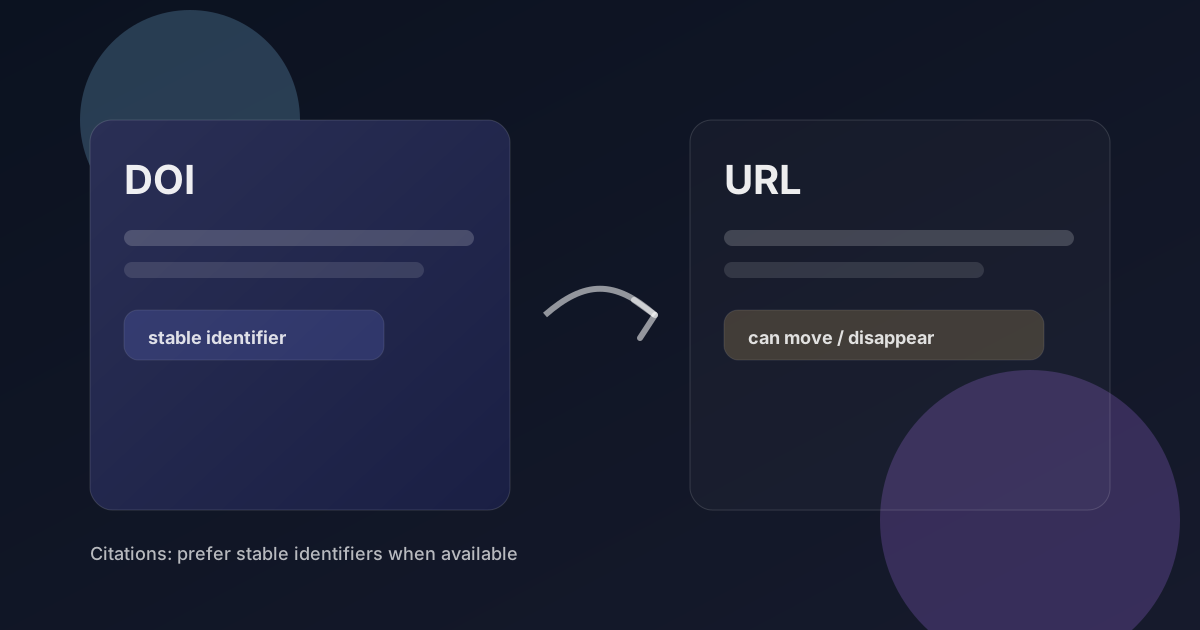
- Prefer identifier-first citations (DOI/PMID/ISBN) over raw URLs for papers and books.
- When importing references, verify title + year + first author for a sample, not just one item.
- Batch-check bibliographies before submission to catch mismatches early.
- When uncertain, label “needs review” so ambiguity doesn’t become a confident error.
Citation drift hurts trust. Readers notice when links don’t support claims. Fixing mismatches reduces bounce and increases the chance your work gets cited accurately — a quiet but powerful growth loop.