

“Needs citation” is a workflow problem, not a writing problem. When a draft is missing citations, the fastest fix is not adding random references — it’s building a clean map from claims to sources.
A claim-first pass scales because it focuses your time on the sentences that carry evidence. You’ll end up with fewer but stronger citations, and fewer fragile links that don’t actually support what you wrote.
Step 1: identify “claim-like” sentences
- Numbers, rates, and comparisons ("increases by", "reduces", "more than", "most").
- Causal language ("leads to", "causes", "results in").
- Strong generalizations ("always", "never", "the best", "the only").
- Specific factual assertions (dates, named entities, policy statements, security guidance).
- Anything that a skeptical reader could reasonably ask: “says who?”
If you can’t find a source quickly, don’t force it. Change the sentence to reflect uncertainty (“we did not verify…”) and mark it for follow-up.
Step 2: turn each claim into a search query
The trick is making the claim searchable. Replace vague language with searchable anchors: key terms, the likely venue, and the measurement you’re asserting.
- Extract the one-sentence claim (no adjectives).
- List 2–3 key terms + a synonym each.
- If there’s a metric/number, include it in the query.
- If the field is known, add the likely venue (journal, standards body, government agency).
- Prefer primary sources; add “review” only when you need background context.
Step 3: attach evidence with a clear strength label
- Primary evidence: the paper/spec/dataset that directly supports the claim.
- Secondary context: review papers, summaries, explainers (good for background, weaker for specifics).
- Operational evidence: vendor docs, policy pages, changelogs (fine when the claim is about that vendor/policy).
This is where most drafts go wrong: a citation can be real but still be the wrong support for the sentence. Treat “supports the claim” as a separate check from “exists.”
Step 4: verify the citation line (metadata match)
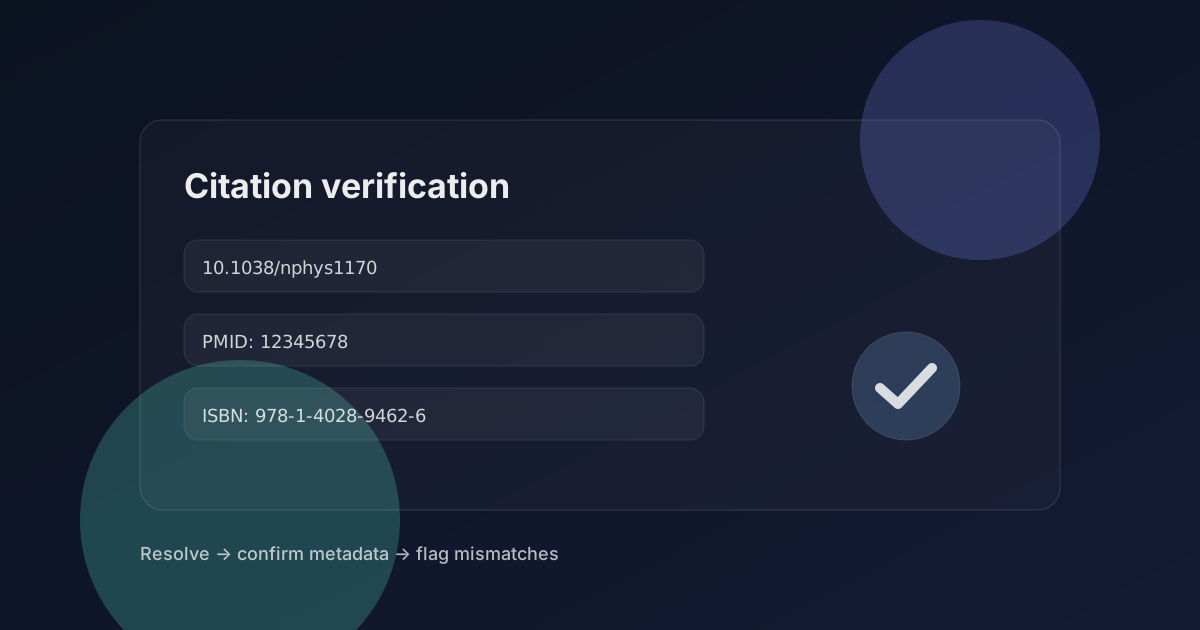
- Resolve DOI/PMID/ISBN when available and confirm title/author/year.
- Avoid URL-only citations for papers when a stable identifier exists.
- If it’s web-native, follow redirects and confirm you end on the canonical domain.
- If anything mismatches, label it “needs review.”
Step 5: fix the writing to reduce “citation pressure”
If you find yourself hunting for a citation that doesn’t exist, the sentence is usually too strong. The fastest fix is to reduce the claim to what you can support, or to turn it into a conditional statement.
- Replace absolutes with bounded language ("often", "in some studies", "in our tests").
- Split one overloaded sentence into “background” + “evidence-backed claim.”
- Avoid attributing intent or causality if you only have correlational evidence.
A lightweight process you can reuse
- Run a claim-first scan and mark claim-like sentences.
- For each claim: attach at least one primary source or label “needs review.”
- Verify citations via identifiers and metadata match.
- Do a final pass: remove weak citations that don’t support the claim.
- Ship with explicit uncertainty labels rather than invented certainty.
A citation & claim checker tool can speed up Step 1 by highlighting claim-like sentences at scale. Treat the tool output as a queue: it helps you find what to review; it doesn’t replace judgment about what needs evidence.
It means the key claims have an accountable source chain. More citations are not automatically better. The goal is verifiability, not volume.